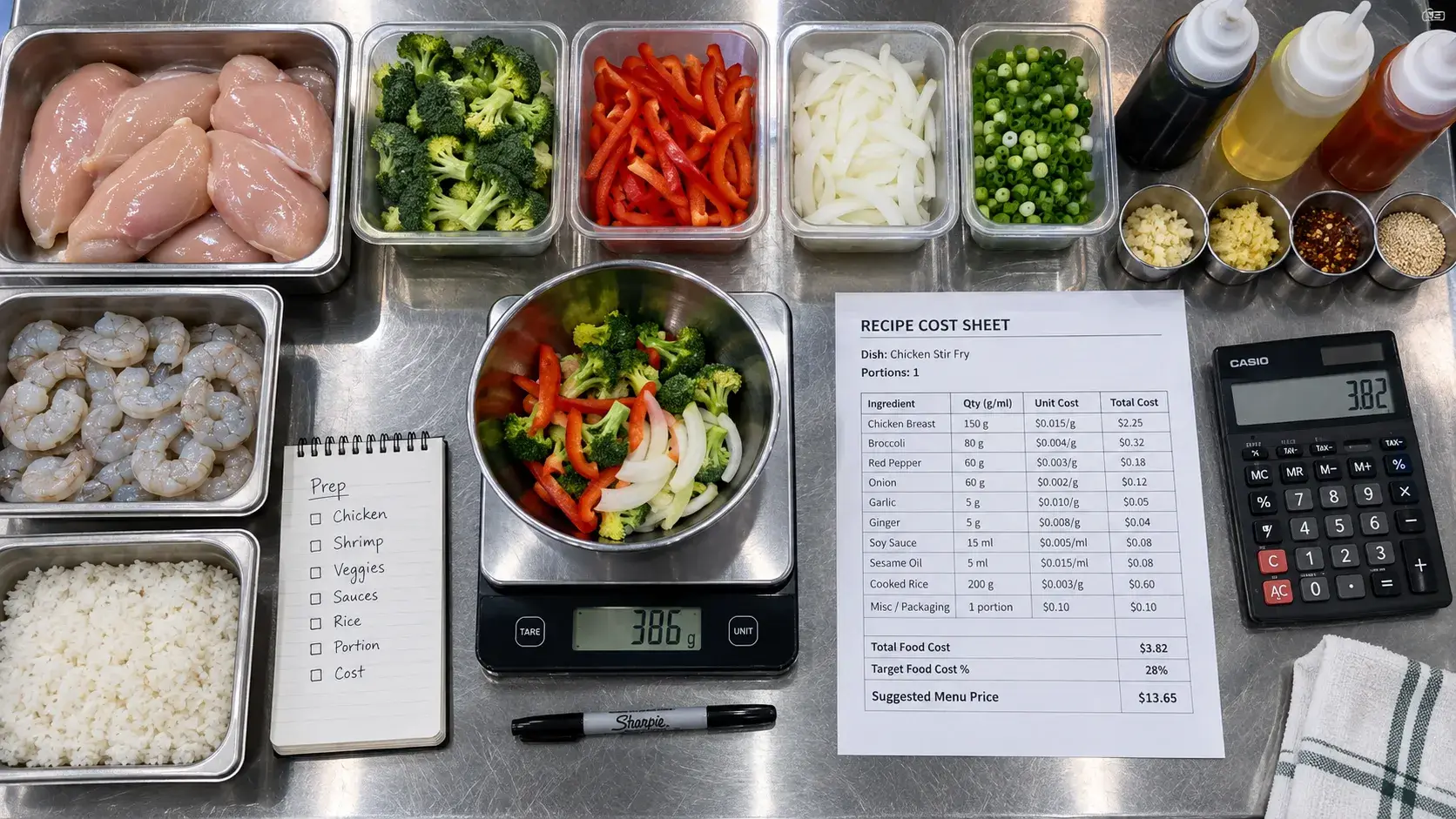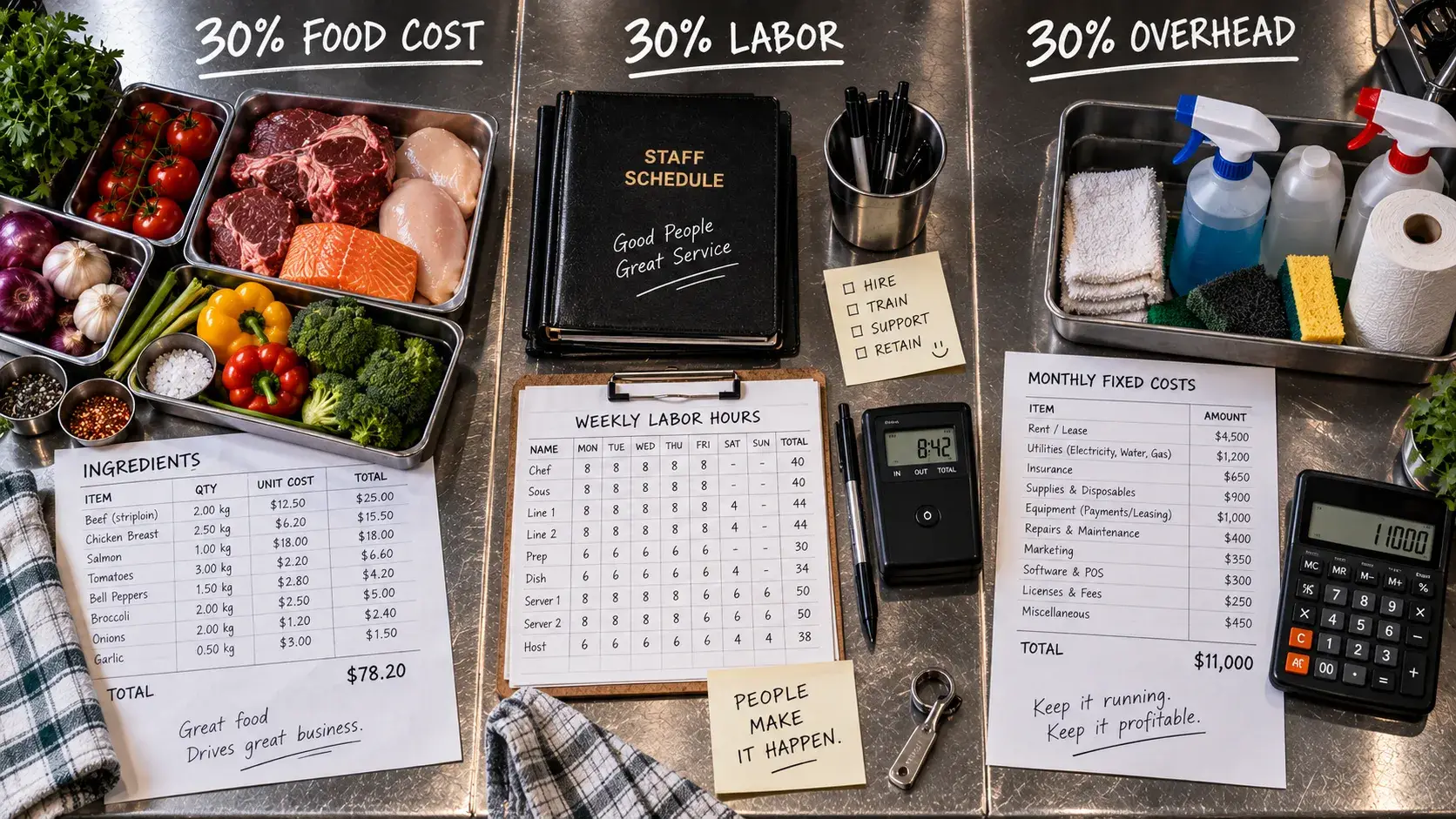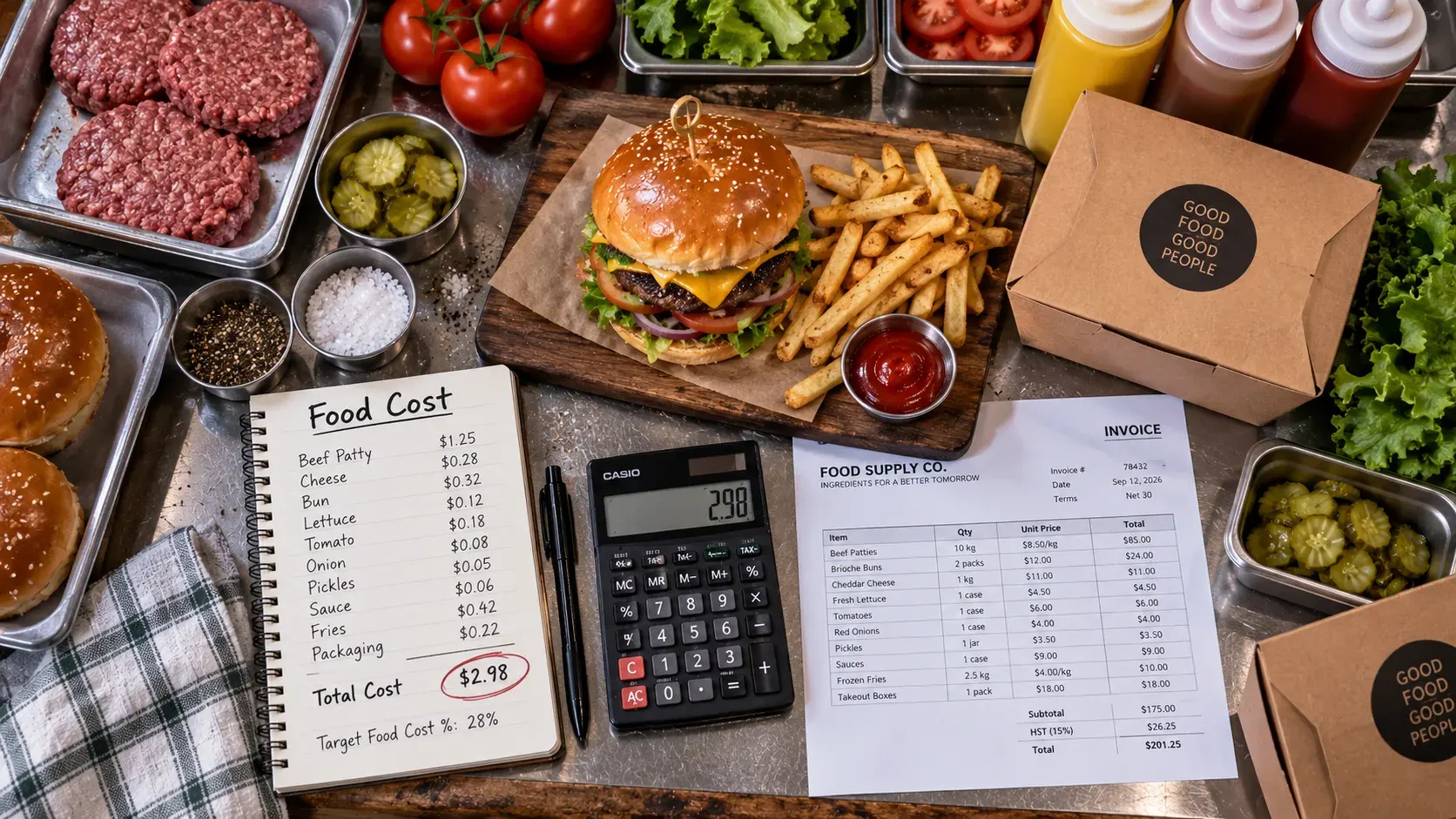
If you’re asking “how do I calculate the cost of a food product,” there’s a good chance you’re in one of three spots:
You’re opening and need prices that won’t bury you.
You’re losing money and don’t know where.
You’re staring at “30% food cost” and realizing that number doesn’t match your bank account.
Most articles give you the clean, theoretical formula… and stop right before reality shows up with a baseball bat.
This post will show you how to calculate a product’s cost step-by-step, including the two most common reasons your “perfect math” still fails:
yield loss (raw vs usable), and
packaging + takeout mix (the silent margin killer).
The Simple Definition
Cost of a food product = what it costs you to produce one sellable portion.
That means:
Ingredients (with yield accounted for)
Packaging (especially for takeout)
Any portion-specific add-ons (sauces, garnishes, condiments)
Not included in product cost (but still important later): labor + overhead. We’ll keep this product-level, but I’ll show you where it fits into the bigger system.
Step 1: Start With Your Recipe Ingredients
List every ingredient that goes into one batch of the item (or one portion if you portion-prep).
For each ingredient, you need:
Purchase unit (case, bag, jug, etc.)
Purchase price
How much of it goes into the recipe (grams/oz/ml/count)
The Core Formula
Ingredient cost per portion = (purchase price ÷ usable units) × units used
But “usable units” is where most people screw this up.
Step 2: Convert Vendor Pricing Into a Cost Per Base Unit
Vendors sell in cases, bags, jugs. You portion in grams, ounces, cups, pieces.
You need a base unit.
Examples:
$84 case of chicken thighs, 20 lb case
$18 jug of sauce, 3.78 L
$52 bag of cheese, 5 kg
Convert:
Cost per lb = 84 ÷ 20 = $4.20/lb
Cost per gram = $4.20 ÷ 453.592 = $0.00926/g
Now your recipe can be priced accurately.
Step 3: Adjust for Yield (This Is the Difference Between Fantasy and Reality)
Yield is the usable percentage after trimming, cooking loss, waste, and shrink.
Examples:
Raw chicken loses weight during cooking
Produce is trimmed
Some items have purge, spoilage, or portioning loss
Yield Formula
True cost per usable unit = cost per unit ÷ yield %
Example:
Raw protein costs $4.20/lb
Yield after cooking/trim is 80% (0.80)
True usable cost:
$4.20 ÷ 0.80 = $5.25/lb usable
Most operators skip this and wonder why their margins “don’t make sense.”
They do. Your inputs were lying.
Step 4: Calculate Portion Cost (With Yield Applied)
Once each ingredient has a true cost per base unit, multiply by how much you use per portion.
Example (simplified burger patty):
Patty uses 180g cooked-weight beef
Your true usable beef cost = $0.0116/g (after yield)
Beef portion cost:
180 × 0.0116 = $2.09
Do that for every ingredient:
Bun
Sauce
Cheese
Lettuce/tomato/onion
Pickles
Fries (if included)
Then sum them.
Total ingredient cost per portion = sum of all ingredient portion costs
Step 5: Add Packaging (Most People Forget This Completely)
If the item is ever sold as takeout (and in most places, it is), packaging is part of cost.
Packaging includes:
Container
Lid
Bag
Cutlery
Sauce cups/lids
Napkins
Example packaging bundle:
Container: $0.28
Lid: $0.11
Bag: $0.20
Utensils: $0.08
Sauce cup: $0.21
Packaging total: $0.88
That’s not “nothing.” On a high-volume item, it’s a profit leak.
Step 6: If You Sell Dine-In and Takeout, Use a Blended Cost
This is the part that separates “food cost math” from “profit reality.”
If an item is 80% takeout, packaging isn’t optional. It’s the cost of doing business.
Blended packaging formula
Blended packaging cost = (takeout % × takeout packaging cost) + (dine-in % × dine-in packaging cost)
Example:
Takeout share: 80% (0.80)
Takeout packaging: $0.88
Dine-in packaging: $0.05 (paper / negligible)
Blended packaging:
(0.80×0.88) + (0.20×0.05)
0.704 + 0.01 = $0.714
So you add ~$0.71 to every unit, because on average, that’s what happens in the real world.
Step 7: Final Product Cost
Final product cost = ingredient portion cost + blended packaging cost
Example:
Ingredients: $5.32
Blended packaging: $0.71
Final product cost:
$6.03
That is your true, sellable unit cost.
The Two Numbers You Must Track: Theoretical vs Actual
Here’s the psychological trap:
Theoretical cost is your recipe math in a vacuum.
Actual cost is what your invoices + waste + yield + portioning errors + comps + theft actually did.
If you only track theoretical, you get false confidence. If you only track actual, you get confusion (“what changed?”).
Real operators track both because:
Theoretical tells you what should happen.
Actual tells you what did happen.
The gap tells you where money is leaking.
That gap is where profit hides.
Common Mistakes That Make Your Cost Wrong
1) Ignoring yield
Raw-to-usable conversion is the #1 reason “my costs don’t match reality.”
2) Treating takeout like dine-in
Packaging + channel mix can turn a “fine” item into a quiet loser.
3) Not updating prices
If your vendor prices changed and your recipes didn’t, your menu is lying.
4) Not tracking both theoretical and actual
You can’t fix what you can’t see.
Where This Fits in the Bigger System
Product cost is step one. It gives you:
food cost %
contribution margin
pricing confidence
a baseline for menu engineering
But profit comes from the full picture: mix, attachment behavior, and operational reality.
That’s why the “30% across everything” mindset breaks restaurants.
If you’re doing this manually, the math isn’t the hard part.
The hard part is:
keeping invoices updated,
maintaining yield assumptions,
tracking packaging creep,
and comparing theoretical vs actual without living in spreadsheets.
That’s the exact problem we’re building MiseUp to solve: real-time food costing that reflects how your kitchen actually runs, not how a recipe card wishes it ran.
If you want, I can show you how MiseUp calculates product cost automatically from invoices + recipes, and flags when the “theoretical vs actual” gap starts widening.
Quick Checklist Summary
To calculate the cost of a food product correctly:
Convert invoice prices into base units (lb/g/ml/count)
Apply yield to get true usable cost
Multiply by portion amounts
Add packaging
Blend packaging cost by dine-in vs takeout mix
Track theoretical and actual over time